
The amount field
The account form asks for one amount, and that box is renamed according to the type you picked. The label is the whole instruction. Read it before typing.
| Tile you clicked | What the box reads | What it wants |
|---|---|---|
| Current accounts, Savings accounts, Crowdlending | Balance (€) | What the account is worth today |
| PEA, Securities account | Cash balance (€) | Only the cash sitting idle in the wrapper |
| Life insurance | Balance (€) | Only what the lines you add will not already cover |
| Loans | Outstanding balance (€) | What is left to repay |
Why a wrapper is different
Section titled “Why a wrapper is different”A PEA and a securities account carry a cash account beside their securities, and the application says so under the box: “An envelope of this type carries a cash account beside its securities. Leave it empty if you have none: it can be stated from the account at any time.”
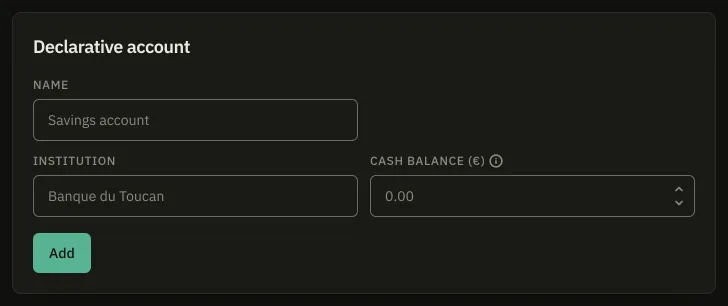
So there are two correct answers for a brand-new PEA: the cash you have not invested yet, or nothing at all if every euro is already in funds. An empty box is a real answer here, not a skipped one.
A life insurance contract gets no such note, but it adds up the same way. State its balance and then add lines to it and both count; the account’s own tab says as much: “This account also carries a balance stated by hand, added to its lines above.”
The loan case
Section titled “The loan case”A loan is the one type whose amount is subtracted instead of added. The form says so under the field: “A loan is a liability: this amount is subtracted from your net worth.” Type what you still owe, as a positive number, and Badlen handles the sign.
Nothing here is final
Section titled “Nothing here is final”A stated amount is a dated row, not a setting. You can restate it, correct it or delete it from the account itself at any time, so a wrong figure on day one costs nothing but a visit. See Fix a mistake.
What the box never does is fill itself in: Badlen connects to no bank. Every balance here is one you declared, and it stays at the value you gave it until you say otherwise. The second term of the sum is the subject of the next page, your first holding.