
Budget
/budget is the cashflow of your current accounts, over a period you choose. Nothing
else feeds it: a savings passbook, a share plan or a wallet never appears here, whatever
it holds.
With no current account on file the page says so and offers to add one. The controls are not drawn before then, because they would narrow a set that does not exist.
The three controls
Section titled “The three controls”| Control | What it does |
|---|---|
| 1M · 3M · 6M · 1A · Custom | The period, counted back from today. Custom adds two date boxes and holds the page until both are filled. |
| The account dropdown | All checking accounts, or one of them. It narrows the totals and the trend block together. |
| Aligned on start of month | Snaps the period to whole calendar months: the start to the 1st, the end to the last day. |
Without that switch, 1M means the last thirty-odd days, straddling two calendar months. Turn it on to compare like with like.
What it totals
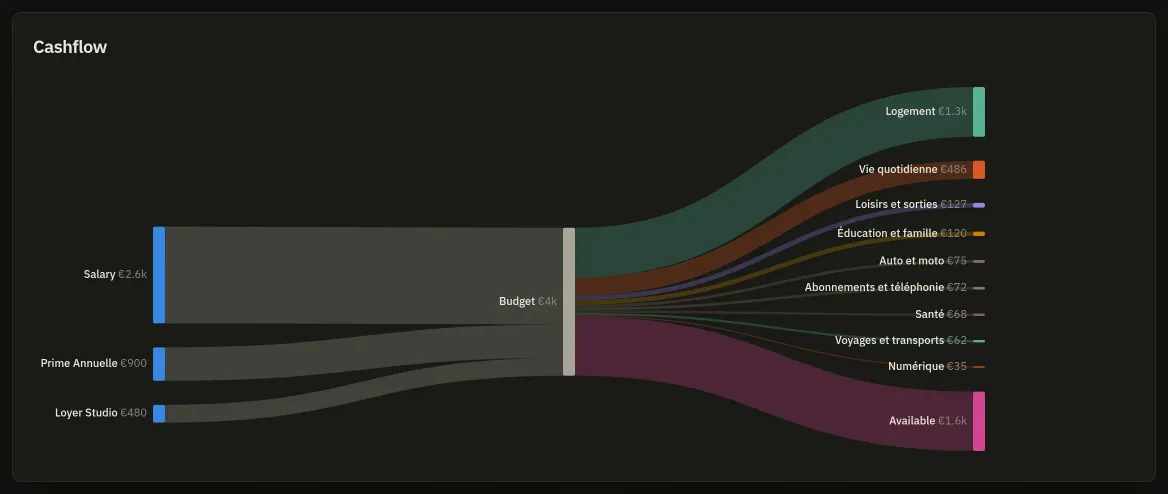
Section titled “What it totals”Four figures: Inflows, Outflows, Available (the difference) and Savings rate (available over inflows, rounded to the whole percent). Below them, one sentence restating all four, then the cashflow diagram: income sources on the left, your spending categories on the right, what is left over as its own branch. The categories are the ones you file operations under. Categories and rules is where they are set.
Over a period longer than a month, the first two figures also read per month, against the last month of the period. A month still running counts only for the days elapsed.
What never counts
Section titled “What never counts”Moving your own money is not cashflow, and two rules take it back out before anything is totalled:
- A transfer between two of your own accounts. The two legs are paired by the same amount on two different accounts within four days of each other, and neither one counts.
- Anything filed under a money-movement family (Mouvements internes and Épargne et placements), which catches the transfers the pairing cannot see, where the other account was never imported. The exclusion follows the family, not its name, so renaming one changes nothing.
Without them, €500 moved to a passbook would read as €500 of spending on one side and €500 of income on the other.
Detected recurring expenses
Section titled “Detected recurring expenses”This card does not read the period above it. It looks over the last twelve months and asks for a shape: the same counterparty charged at a monthly cadence, with amounts that agree, and a charge recent enough to still be running. Twenty rows at most, biggest first.
Trends
Section titled “Trends”The last block draws income, expenses and savings rate month by month. It follows the period chips, with a floor of six months: below that, a trend has too few points to read, so 1M and 3M both draw six. A custom period says nothing about how many months to trend over, so it draws twenty-four. The block names the span it is showing, every time.