
Simulators
Simulators, at /outils, holds eight calculators in one place: a rail lists them, the
selected one fills the panel beside it, and the address names it. Each has its own URL, so
one can be bookmarked or linked to directly.
They are scratch pads, not reports. Only one of them reads your accounts.
The eight
Section titled “The eight”| Simulator | What it answers | Address |
|---|---|---|
| Wealth simulator | The monthly passive income your wealth could pay, after tax and inflation. | /outils/simulateur-patrimoine |
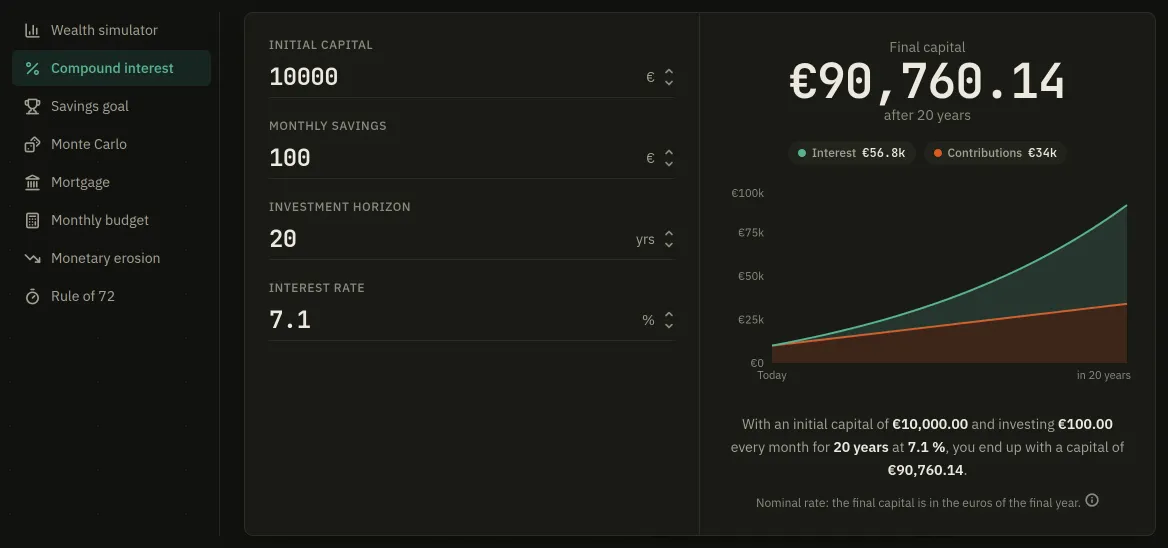
| Compound interest | What an initial capital plus a monthly effort becomes at a given rate. | /outils/interets-composes |
| Savings goal | The monthly saving needed to reach a target by a date. | /outils/objectif-epargne |
| Monte Carlo | The same projection, replayed across 3,000 randomly drawn markets. | /outils/monte-carlo |
| Mortgage | A monthly payment and a loan’s total cost, or the amount you could borrow: two modes, one chip switches them. | /outils/pret-immobilier |
| Monthly budget | A budget drawn as a flow, from figures you type. | /outils/budget-mensuel |
| Monetary erosion | What inflation takes from a capital’s purchasing power. | /outils/erosion-monetaire |
| Rule of 72 | Roughly how long a capital takes to double. | /outils/regle-72 |
The addresses stay French: they are bookmarked and linked from the course shipped with
the product, at /apprendre.
What they assume
Section titled “What they assume”The two that project a capital forward, Compound interest and Savings goal, work in nominal euros: the result is in the euros of the final year, not today’s. The rate you type is an effective annual rate, and monthly contributions are invested at the end of each month. Each card says so under its result.
Wealth simulator does the opposite: it deflates by its own inflation field, so its amounts are in today’s euros.
Monte Carlo is the answer to the weakness all the others share. They compound one average, and an average almost never happens: two portfolios with the same average return end one broke and one rich, depending on whether the bad decade falls early or late.
Your figures, and where they live
Section titled “Your figures, and where they live”Every simulator but Monte Carlo starts from defaults and keeps whatever you type in this browser, so a calculator you come back to is where you left it. That storage is local: it is not saved to your account, does not follow you to another device, and is not part of any export or backup.
Monte Carlo is the exception twice over: it reads your current net worth as its starting capital, and it keeps nothing. You can type over that figure, and nothing is written back to your accounts.
This screen is unrelated to Budget, which reads your real current accounts. The simulator knows only what you type into it.