
Advice
Advice (/conseils) reads the portfolio you have actually entered and writes what it
finds. There is nothing to fill in and nothing to submit: open it and read.
Portfolio health
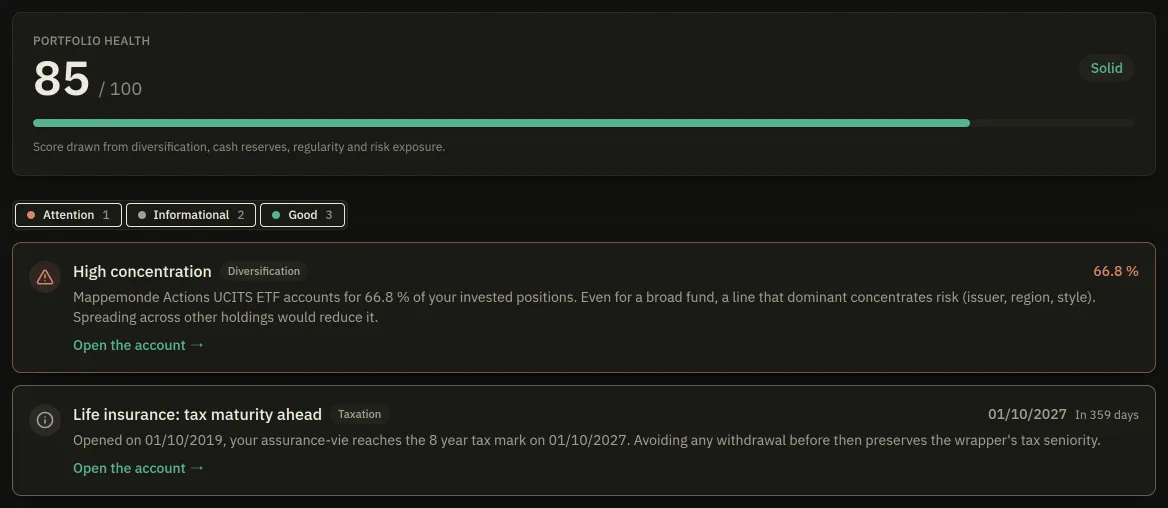
Section titled “Portfolio health”A score out of a hundred sits at the top, with a band: Solid at 80 and above, Fair from 60 to 79, Needs attention below. It is the average of the dimensions that actually applied to you, and a dimension that could say nothing is not counted as a zero.
Six dimensions score it: diversification, cash, regularity, crypto, wrappers and fees. With nothing to analyse yet, the card says so (unknown health, not perfect health) and offers to add an account.
A seventh family, Caps, writes cards without scoring anything: an envelope filled to its legal ceiling is a plan that worked, not a fault.
The cards
Section titled “The cards”Each card carries a severity, a title, one sentence of detail, and often a figure:
| Level | What it means |
|---|---|
| Attention | Something is worth looking at now |
| Informational | Worth knowing, nothing to do |
| Good | Settled; it is here so you can see it is settled |
There is no fourth level and no alarm. In a wealth tracker nothing arrives fast enough to deserve one.
The list is sorted with Attention first. Filter by level is three toggles, each showing how many cards it holds, so a level that holds nothing still tells you so. Untick all three and the page says which to tick to read your advice again.
A card that counts down to a day shows the day and how far off it is: In 14 days, More than 2 years ago. Most cards count down to nothing and show neither.
Following a card
Section titled “Following a card”Where the subject has a screen of its own, the card ends with a link to it: the account, the category, the emergency fund, or the fees page. The payment-ceiling card is the one exception that does not open the account’s first tab: it goes straight to the account’s Settings tab, where the figure it talks about is stated.
What it reads
Section titled “What it reads”Diversification looks at how much of your invested book sits in a single line. Cash and crypto are measured as shares of your wealth. Regularity counts how many of the last twelve calendar months carry a dated buy order, so it says nothing until you record orders. Tax reads your wrappers, caps read what you declared paying in, and fees read the ongoing charges of your lines. The advice is only as good as what you have entered.